Aquarium Design, Installation and Maintenance, Thousand Oaks, CaliforniaMarine Aquarium Maintenance and Installation, Thousand Oaks, California

Marine Clownfish


-
Browse the Categories to the right, or enter a topic here

Looking for books 
on this subject ?

  The Marine Aquarium Handbook : 
Beginner To Breeder


  Clownfishes


  Anemone Fishes and Their Host Sea Anemones


The Conscientious
Marine Aquarist
The Conscientious Marine Aquarist, Bob Fenner

Ultimate Marine Aquariums
Ultimate Marine Aquariums by Mike Paletta
Saltwater Dream Systems

  New Marine Aquarium
Fish Tank Books - New Marine Aquarium

Your First Marine Aquarium 
Fish Tank Book - Your First Marine Aquarium

Angelfishes & Butterflyfishes
Angelfishes & Butterflyfishes by Scott Michael

A Guide To
A Guide To Angelfishes and Butterflyfishes by Allen, Steene, Allen
Angelfishes & Butterflyfishes

CORALS:
A Reference Guide

Aquarium Corals : Selection, Husbandry,...

The Coral Reef Aquarium : 
An Owner's Manual

Successful Reef Aquarium 

Natural Reef Aquariums Simplified...

Dynamic Aquaria : 
Building Ecosystems


The Reef Aquarium : 
Volume 1

The Reef Aquarium : 
Volume 2


Clownfish Egg Incubation

By Stanley Brown
The Breeders Registry

Incubation periods vary between the species and water temperature also affects development, but typically the eggs will hatch on the 6th to 10th night after the eggs were laid.  The eggs undergo several distinct color changes as they develop; the eyes are usually visible by day 3-4 followed by a change in overall darkening of the coloration to a orange-tan purple, followed by a silver/quicksilver color just prior to hatching.  The exact coloration may vary, but the silver/quicksilver coloration with distinctly visible eyes is usually a good indicator that the eggs will hatch within a night or two.
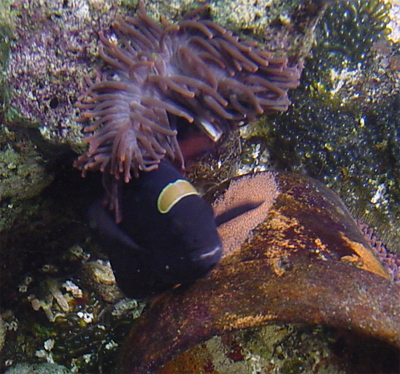
clownfish eggs

The aquarist need do little during this period as the adults will care for the eggs, constantly guarding, fanning, and removing undeveloped eggs.  Occasionally the adults may eat the eggs.  This is not uncommon with newly spawning pairs.  Generally this behavior abates after several spawns, but in some instances it may be necessary to separate the pair and re-pair with other fish..  During the incubation, feed normally and avoid disturbing the pair or the system (not a good time for a thorough cleaning, although some have reported that the pair seemed unconcerned with major activity by the aquarist.  EACH pair is different.


i- Fautine, Daphne G. & Allen, Gerald, R., 1994, Anemonefishes  and their Host Sea Anemones, Tetra Press, Germany. 
ii- Personal communication, 2000, Joe Lichtenbert, Reef Propagation’s, USA.
iii- Ibid. i
iv- Moe, Martin Jr., A., 1989, The Marine Aquarium Reference: Systems and Invertebrates, Green Turtle Publications, USA
v- Wilkerson, Joyce D., 1998, Clownfishes: A Guide to their Captive Care, Breeding & Natural History;  ,Microcosm Ltd., USA
vi- Brown, Stanley D., 1998,  Low Tech Larval Trap, The Journal of MaquaCulture, Vol 6:1-17


Visit the Aquarium Design home page


Acrylic aquariums, Fish Tanks, Aquarium StandsAcrylic aquariums, Fish Tanks, Aquarium Stands

Acrylic aquariums, Fish Tanks, Aquarium Stands

' Build Your Aquarium On-Line '

___________________________________________


Jellyfish, Pankton Kreisel, Jellyfish Tanks

Jellyfish, Jellyfish Tanks and Plankton Kreisel

___________________________________________

 
MACNA X, Marine Aquarium Conference of North America 1998 The Tenth Annual Marine Aquarium Conference Of North America

MACNA X
Presentation DVD's


September, 27, 28 and 29, 1998
Long Beach, California

Jim Wolf, Tyree, Fenner, Hovanec, Knop, Borneman, Goemans, Leng, Thiel, Pellata, Frakes, Carlson, Sprung, Riddle, Brockmann, Delbeek, Adey.