-
Browse the Categories to the right, or enter
a topic here
Looking for books
on this subject ?
The Conscientious
Marine Aquarist
Ultimate Marine Aquariums
 Saltwater
Dream Systems
CORALS:
A
Reference Guide
Aquarium
Corals : Selection, Husbandry,...
The
Coral Reef Aquarium :
An
Owner's Manual
Successful
Reef Aquarium
Natural
Reef Aquariums Simplified...
Dynamic
Aquaria :
Building
Ecosystems
The
Reef Aquarium :
Volume
1
The
Reef Aquarium :
Volume
2
|
|
|
Acropora, staghorn, or sps are all part of what can be called the 'small
polyped stony' corals ( although some may argue against it ). The reason
for the term is that these corals are comprised of small polyps which deposit
and form encrusting or branching forms.
Of the four basic groups of corals in the hobby ( ie: colonial polyps,
soft corals, hard corals and SPS corals ) they were the last group available
to the hobby. Their appeal is due to the variety of colors, fast growth,
and 'frag-ability'.
Their colors range from brown, brown with colorful tips to brilliant
greens, blues and reds.What determines their color is still a subject that
is highly debatable. Some believe it is the result of high alkalinity and
carbonate hardness of the water. Others believe it is due to the intensity
or high 'kelvin' temperature color of the lights. It is agreed though that
very strong lighting, such as metal hilide lighting, is a requirement.
Under the more intense lighting, along with strong water flow and calcium
supplements, these corals can grow at a rather excellerated pace. Some
can grow up to 4 or 6 inches per year in a captive enviroment.
As hobbyists achieve greater sucsess with these corals the need to prune,
trim or thin-out a colony becomes necessary. By snipping branches off an
existing colony and adhering them to another rock, or spot, the coral can
recuperate and start an entirely new colony. This process in the hobby
is refered to as ' fragging' or fragmentation.
|

Branching
species
|

|
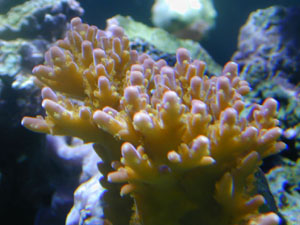
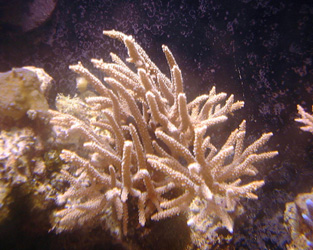
Branching Staghorn Coral
Acropora multiacuta
A central base radiating outwards, possibly table-like, into many branches. |
|

|
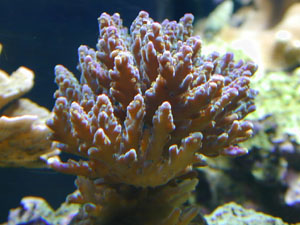
Branching Staghorn Coral
Acropora azurea ( ?)
A central base radiating outwards into many branches. |
|

|
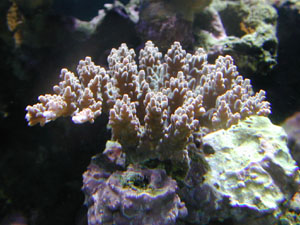
Branching Staghorn Coral
Acropora sp.
A central base radiating outwards, possibly table-like, into many branches. |
|

|
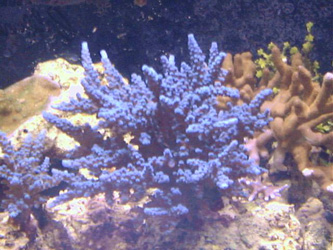
Blue Staghorn Coral
Acropora Tortuosa
A central base radiating outwards into thick branches. Generally sky
blue in color. |
|

|
Branching Staghorn Coral
Acropora Microphthalma
A central base radiating outwards into many branches. Fast growing. |
| Plating |
|
|

|
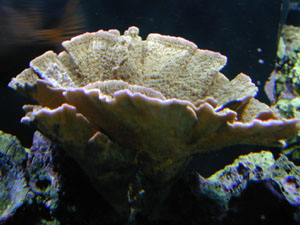
Vase Coral
Montipora capricornus
Dish or vase shaped with folds in its shape. Leading edges can be of
bright color. |
|

|
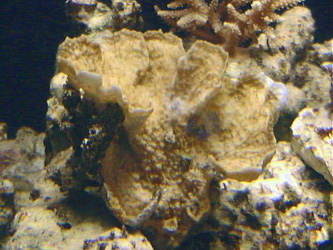
Vase Coral
Montipora capricornus
Dish or vase shaped with folds in its shape. Leading edges can be of
bright color. |
| Encrusting |
|
|

|
Encrusting Coral
Acropora abrolhensis
Plating or encrusting form. Branches can develope and extend away from
its base. Polyps can envelope the entire base and branches. |
|

|
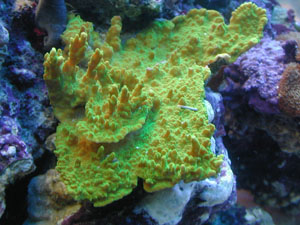
Screaming Green Coral
Montipora sp.
Plating or encrusting form. Branches can develope and extend away from
its base. Polyps are very small and sparse. |
|

|
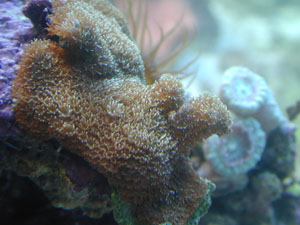
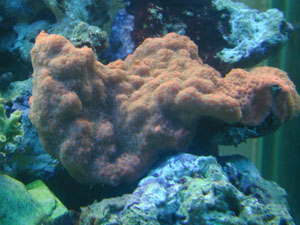
Encrusting Red Coral
Montipora efflorescens
Plating or encrusting form. Branches can develope and extend away from
its base. Polyps envelope the entire base and branches. |
|

|
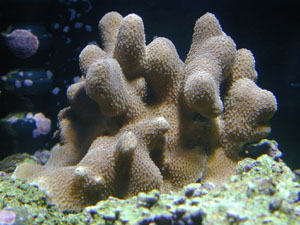
Encrusting Porites
Porities cylindrica
Plating or encrusting form. Thick branches develope and extend away
from its base. Polyps envelope the entire base and branches. |
Visit the Aquarium Design home page

|
 
Acrylic aquariums, Fish Tanks, Aquarium Stands
' Build Your Aquarium On-Line '
___________________________________________
|

Jellyfish,
Jellyfish
Tanks and Plankton Kreisel
___________________________________________ |
|
|
The Tenth Annual Marine Aquarium Conference Of North America
MACNA X
Presentation DVD's
September, 27, 28 and 29, 1998
Long Beach, California
Jim Wolf, Tyree, Fenner, Hovanec, Knop, Borneman, Goemans, Leng, Thiel, Pellata, Frakes,
Carlson, Sprung, Riddle, Brockmann, Delbeek, Adey. |
|